


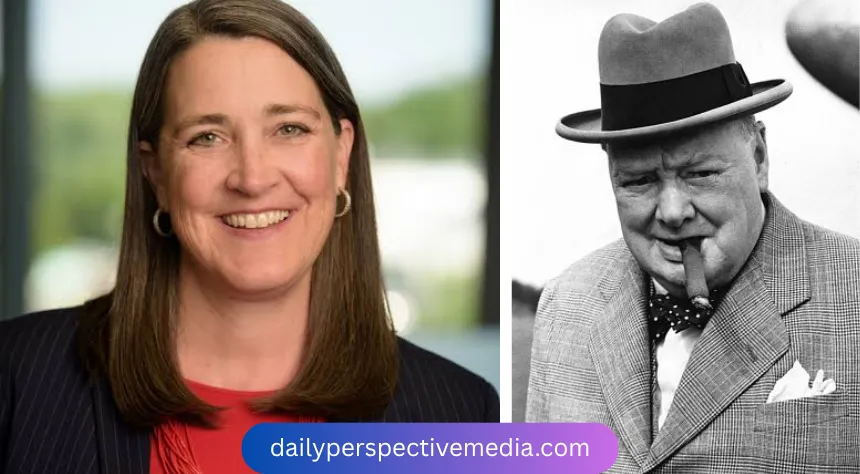
Patricia Poppe and Winston Churchill built their reputations in different countries, professions, and historical periods. Poppe, widely known as Patti Poppe, is an American energy executive whose career spans manufacturing and utilities. Churchill was a British politician, wartime prime minister, soldier, and writer. This article brings their biographies together as a comparison of leadership and public responsibility, rather than suggesting a personal connection. Their stories raise useful questions: How do leaders prepare for demanding roles? How do they respond when confidence weakens? Most importantly, how should their achievements be weighed against mistakes, criticism, and the real consequences of their decisions?
Patricia Poppe Education and Professional Foundation
Patricia K. Poppe developed her professional foundation through engineering and management education. She earned both a bachelor’s degree and a master’s degree in industrial engineering from Purdue University, followed by a master’s degree in management from Stanford University’s Graduate School of Business. These subjects connect closely with her later responsibilities. Industrial engineering examines how people, equipment, and processes work together, while management education considers organizational decisions and business performance. Her education helps explain the operational focus visible throughout her career. Rather than entering energy leadership through politics or finance alone, Poppe brought technical training alongside experience managing complex workplaces and large teams.
From General Motors to the Energy Industry
Before becoming a prominent utility executive, Patti Poppe held plant management positions at General Motors. She later moved into the electricity industry and served as a power plant director at DTE Energy. That progression placed her close to the practical demands of industrial operations before she assumed wider corporate responsibilities. Manufacturing plants and power stations differ, but both require coordinated maintenance, trained employees, dependable equipment, and careful attention to safety. Her movement between these industries provides an important part of her biography: the executive career grew from operational work. It also offers context for her later emphasis on improving everyday processes within utility businesses.
Leading CMS Energy and Consumers Energy
Poppe joined Consumers Energy in 2011 and advanced through positions covering customer operations, rates, regulation, engineering, and energy distribution. On July 1, 2016, she became president and chief executive officer of CMS Energy and Consumers Energy, succeeding John Russell. This appointment expanded her responsibilities from individual business functions to the direction of an entire utility organization. Her earlier roles had exposed her to both the physical energy network and the experience of customers using it. That combination matters because utility leadership involves more than producing electricity or delivering gas. It also requires working with regulators, planning investment, and explaining decisions to the communities served.

Joining PG&E During a Difficult Recovery
Patricia Poppe became CEO of PG&E Corporation on January 4, 2021, following an appointment announced in November 2020. The move brought her to a California utility group facing major questions about safety and public confidence after destructive wildfires and bankruptcy. Her appointment represented a substantial change in scale and public exposure. Leading such an organization requires confronting inherited problems while accepting responsibility for present decisions. For readers comparing Patricia Poppe and Winston Churchill, this is a meaningful point of discussion: both assumed prominent leadership positions during difficult circumstances. However, a regulated company’s recovery and a nation’s wartime survival involve fundamentally different powers, responsibilities, and human stakes.
Wildfire Safety and Underground Power Lines
Wildfire prevention is a central issue in Poppe’s PG&E leadership. One major approach involves moving selected overhead power lines underground, reducing their exposure to conditions that can cause electrical ignitions. In October 2026, PG&E publicized a proposed ten-year plan covering approximately 5,000 additional miles of underground distribution lines. A proposal must be distinguished from completed construction, and company forecasts should be read as estimates rather than guaranteed results. The broader leadership challenge is straightforward to understand: identify dangerous conditions, choose effective protections, and carry out the work reliably. Progress must ultimately be assessed through evidence of safer infrastructure and reduced risk to surrounding communities.
Affordability Reliability and Public Accountability
Safety improvements also raise difficult questions about electricity bills, investment, and service reliability. Poppe’s leadership remains subject to public scrutiny because customers experience utility decisions through monthly costs and the dependability of their power supply. Reporting in October 2026 described disagreements between PG&E and San Francisco over the potential cost of transferring local electricity infrastructure into public ownership. The competing valuations illustrate how strongly different parties can disagree about the same essential service. A balanced biography should therefore examine corporate explanations alongside customer concerns and government responses. Public confidence depends on measurable results, clear communication, and credible accountability when performance falls short of what communities reasonably expect.
Winston Churchill Childhood and Education
Winston Leonard Spencer Churchill was born on November 30, 1874, at Blenheim Palace in Oxfordshire, England. His father was Lord Randolph Churchill, a British politician, and his mother was Jennie Jerome, an American-born member of a wealthy family. His privileged background provided connections and opportunities, although family life also included emotional distance from his parents. Churchill attended Harrow and trained at Sandhurst before entering military service. His upbringing differed considerably from the educational and professional route associated with modern corporate leadership. Understanding this aristocratic setting helps readers place his ambitions, outlook, and early opportunities within the social structure of late Victorian Britain.
Military Service Journalism and Political Ambition
Churchill’s early adult life combined military service, journalism, and writing. Commissioned into the 4th Hussars in 1895, he sought opportunities to observe or participate in overseas campaigns. His reporting and books helped make his experiences known to a wider audience. These activities were closely connected: military adventures supplied material, while published accounts helped build his reputation and income. His career also unfolded within the expansion and enforcement of British imperial power, an essential context for understanding these experiences. Before becoming a national political leader, Churchill had already learned how personal storytelling could shape public attention. That skill later became a defining feature of his political identity.
Political Advancement and the Gallipoli Setback
Churchill won election to Parliament in 1900, representing Oldham as a Conservative, and joined the Liberal Party in 1904. He later held major government offices, including First Lord of the Admiralty. His career suffered a serious setback through his association with the failed Dardanelles and Gallipoli operations in 1915. These events brought heavy criticism and damaged confidence in his judgment. They also show why a biography centered only on his later wartime success would be incomplete. Churchill’s rise involved political changes, controversial choices, and periods of exclusion. His eventual return to leadership followed a long career in which ambition and ability existed alongside substantial errors.
Winston Churchill Leadership During the Second World War
On May 10, 1940, Churchill became British prime minister as Nazi Germany’s military advances threatened Europe. His government faced the evacuation from Dunkirk, the danger of invasion, and sustained attacks on British cities. Churchill’s speeches helped communicate determination during this period, while his responsibilities also included military coordination and diplomacy. Britain’s survival and the eventual Allied victory depended on far more than one leader: armed forces, civilians, Commonwealth contributions, and international partners were indispensable. Churchill worked closely with Franklin D. Roosevelt and, after Germany invaded the Soviet Union, Joseph Stalin. His historical importance rests partly on sustaining cooperation among allies with different interests and political systems.
Books the Nobel Prize and Later Life
Churchill’s public identity extended beyond political office. His books included The World Crisis and the multivolume The Second World War, combining historical narrative with his perspective on events he had helped shape. In 1953, he received the Nobel Prize in Literature, an important distinction that is sometimes mistakenly described as a peace prize. He served a second term as prime minister from 1951 to 1955, then remained a member of Parliament until 1964. Churchill died on January 24, 1965, aged 90. His writing remains valuable, although readers should recognize that a participant’s account presents an interpretation rather than a complete, detached record.
Empire Race and the Contested Legacy of Winston Churchill
Churchill’s opposition to Nazi Germany remains central to his reputation, but his imperial convictions and racial attitudes also require serious examination. He opposed Indian political advancement, and his government’s response to the Bengal famine of 1943 remains a major subject of criticism and historical debate. Scholarship on Churchill, India, and race challenges biographies that discuss wartime leadership without considering colonial populations. A responsible assessment must examine whose security and political rights received priority, and whose suffering received insufficient attention. Recognizing Churchill’s role in resisting Hitler does not settle every question about his record. Historical judgment requires considering achievements alongside the consequences of power for different communities.
Patricia Poppe and Winston Churchill Comparing Leadership
A useful comparison of Patricia Poppe and Winston Churchill concerns leadership under scrutiny, rather than equal historical importance. Their biographies suggest three questions readers can apply to powerful figures: What expertise did they bring? How clearly did they explain difficult choices? What happened to the people affected? These are interpretive questions, not evidence that Poppe adopted Churchill’s methods or drew inspiration from him. Corporate leadership operates through boards, regulation, employees, and customers; political leadership involves public institutions and democratic authority. Comparing their careers can sharpen an understanding of accountability, provided the differences remain visible. Confidence and communication matter, but neither can substitute for sound decisions and demonstrable results.
Conclusion
Patricia Poppe and Winston Churchill offer contrasting biographies of responsibility, ambition, and public judgment. Poppe’s professional story centers on engineering, industrial operations, and the continuing challenges of utility leadership. Churchill’s historical significance includes wartime government, influential writing, political reversals, and a deeply contested imperial legacy. Reading their lives together is most useful when comparison encourages careful questions rather than simple praise. Leaders should be assessed through their preparation, decisions, and effects on others. Their circumstances also matter: success in one field cannot be measured automatically against success in another. A balanced biography preserves these distinctions while helping readers understand why leadership attracts both admiration and demanding public scrutiny.
FAQs
Who Is Patricia Poppe
Patricia Poppe, commonly called Patti Poppe, is an American business executive whose career includes senior positions in manufacturing and the energy industry. As of October 25, 2026, PG&E’s official leadership information identifies her as chief executive officer of PG&E Corporation. She previously led CMS Energy and Consumers Energy. Her professional background is particularly relevant to readers interested in how technical and operational experience can lead to executive responsibility. When researching her career, use her full name and familiar name together because official announcements and interviews may use either. The organization named in a job title also matters, particularly when distinguishing a parent corporation from its operating utility.
Who Was Winston Churchill
Winston Churchill was a British statesman, military veteran, author, and twice-serving prime minister. His terms in office ran from 1940 to 1945 and 1951 to 1955. He is best known internationally for leading Britain’s wartime government against Nazi Germany, although his public career began decades earlier and continued after the war. Readers should approach him as a complex historical figure rather than relying only on famous speeches or photographs. His record includes political changes, strategic failures, literary achievements, and controversial positions on empire. A rounded biography explains these elements together, allowing admiration for particular achievements to coexist with critical examination of other decisions and beliefs.
Were Patricia Poppe and Winston Churchill Connected
The verified biographical sources used for this article do not establish a personal, family, or professional connection between Patricia Poppe and Winston Churchill. Their names appear together here because the article compares two separate leadership careers. That distinction matters when reading online biographies: a combined headline does not prove that its subjects met, worked together, or influenced one another. Nor does a shared theme such as resilience establish a documented relationship. Any claim that Poppe followed Churchill’s leadership philosophy would need direct supporting evidence, such as a reliable interview or published statement. Without that evidence, the comparison should remain an editorial interpretation of their different experiences.
What Did Patricia Poppe Study
Poppe studied industrial engineering at Purdue University, earning bachelor’s and master’s degrees, and later earned a master’s degree in management at Stanford. This combination brings together technical systems and organizational decision-making. It is relevant to her career because utilities depend on coordinated networks of equipment, maintenance, employees, and investment. However, academic qualifications alone do not explain a leader’s performance; workplace experience and the quality of subsequent decisions also matter. Readers considering a similar career can view her education as one route into operational leadership rather than a guaranteed formula. Her biography illustrates how engineering training may support management responsibilities that extend well beyond a single technical specialty.
Why Did Churchill Receive the Nobel Prize
Churchill received the 1953 Nobel Prize in Literature for his contribution to historical and biographical writing and his distinguished oratory. The award recognized his use of language and narrative, rather than functioning as a general endorsement of every political decision he made. His literary career is important because writing supported both his livelihood and public reputation across many years. It also helped shape how later audiences understood the conflicts in which he participated. Readers using his books for research should compare them with other historical accounts and archival evidence. Their author possessed exceptional access to events, but he also had personal views and a reputation to defend.
What Can Readers Learn From Their Careers
The careers of Patricia Poppe and Winston Churchill encourage readers to distinguish leadership image from leadership performance. Preparation, persistence, and effective communication can help someone manage difficult responsibilities, but these qualities need to be tested against outcomes. In evaluating either biography, ask what decisions were made, what alternatives existed, and who carried the consequences. This approach avoids treating every setback as proof of failure or every achievement as proof of flawless judgment. It also leaves room for changing assessments as new evidence appears. The most useful lesson is therefore a method of evaluation: understand the circumstances, examine reliable records, and keep the experiences of affected people in view.