


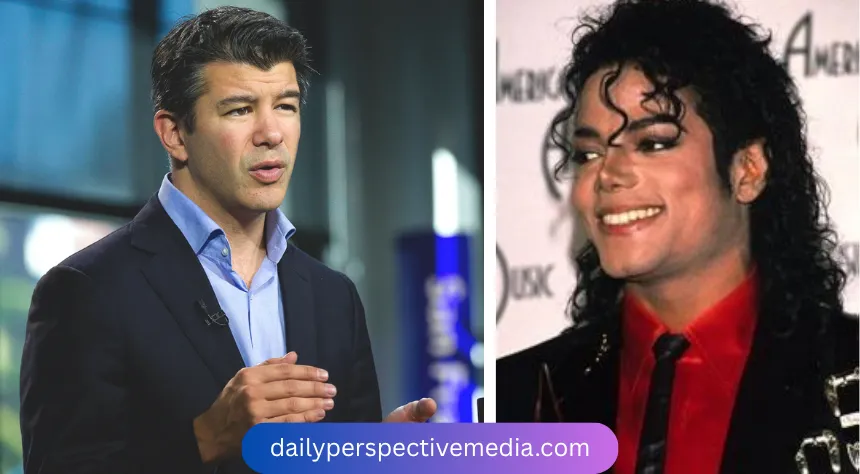
Michael Jackson and Travis Kalanick became famous in very different fields, yet both helped change how people experienced everyday culture. Jackson brought exceptional singing, dance, and visual storytelling to popular music. Kalanick helped expand smartphone-based transportation through Uber before moving into food infrastructure and industrial automation. Reading their biographies together offers a useful comparison of ambition, reinvention, and public accountability. This article presents their separate life stories rather than suggesting a shared career or documented partnership. It follows Jackson from his Indiana childhood to worldwide recognition, then traces Kalanick from early internet ventures to his latest work, using established records and current sources checked on October 28, 2026.
Michael Jackson Childhood and Family Background
Michael Joseph Jackson was born on August 29, 1958, in Gary, Indiana, to Joseph and Katherine Jackson. Music was part of the family environment, and Michael began performing while still a young child. His father organized and managed the brothers’ early musical work, while rehearsals and local appearances gradually became professional commitments. That upbringing helps explain the remarkable confidence audiences later saw onstage: his experience began long before adulthood. It also placed the demands of entertainment at the center of his childhood. Any account of Jackson’s development should recognize both his early talent and the unusually intense training and public exposure that accompanied his rise through the family group.
The Jackson 5 and the Move Into Solo Music
As the young lead singer of the Jackson 5, Michael performed alongside Jackie, Tito, Jermaine, and Marlon. Their Motown breakthrough produced four consecutive American number-one singles: “I Want You Back,” “ABC,” “The Love You Save,” and “I’ll Be There.” His expressive voice helped make the group’s records appealing across age groups, while television appearances introduced his dancing and personality to wider audiences. Solo recordings followed while he remained active with his brothers, and “Ben” reached number one in 1972. This gradual transition matters because Jackson’s solo success grew from years of ensemble performance. He learned how to deliver a memorable song within a demanding professional system before becoming its central attraction.
Off the Wall and the Thriller Breakthrough
Off the Wall, released in 1979, established Jackson’s adult solo identity through an accessible blend of dance rhythms, soul, and pop. Working with producer Quincy Jones, he recorded songs including “Don’t Stop ’Til You Get Enough” and “Rock with You.” Their collaboration continued with Thriller in 1982, whose appeal extended across musical formats through tracks such as “Billie Jean” and “Beat It.” Thriller became the best-selling album worldwide, although published lifetime sales estimates vary. Its achievement reflected both the recordings and the imaginative presentation surrounding them. For readers comparing Michael Jackson and Travis Kalanick, this period demonstrates how a distinctive creative offering can grow into a recognizable global brand.

Dance Music Videos and Later Albums
Michael Jackson made movement central to his public identity, with the moonwalk becoming closely associated with his performance style. His music videos treated songs as opportunities for choreography, character, and dramatic storytelling, encouraging audiences to watch as attentively as they listened. Bad in 1987 continued his commercial success and generated five number-one singles on the Billboard Hot 100. Later albums included Dangerous in 1991, HIStory in 1995, and Invincible in 2001. These releases show that his career extended well beyond one blockbuster album. His influence can be understood through the expectations he helped establish: a major pop release could combine carefully produced recordings, striking screen performances, and a highly recognizable visual identity.
Personal Life Fatherhood and Humanitarian Work
Jackson’s family life attracted persistent attention, including his marriages to Lisa Marie Presley and Debbie Rowe. He had three children, widely known as Prince, Paris, and Bigi, whose privacy became an enduring subject of public interest. His humanitarian work formed another part of his public identity. He co-wrote “We Are the World” with Lionel Richie, connecting popular music with fundraising for African famine relief. Songs such as “Heal the World” also expressed concern for children and human suffering. These activities belong in a rounded biography, alongside his recordings and performances. They should be described through specific projects rather than unverified donation totals or assumptions about a celebrity’s private motivations.
Allegations the Settlement and the Criminal Acquittal
Jackson’s biography also includes allegations of child sexual abuse, which he denied. A civil lawsuit involving one accuser was settled in 1994. In a separate criminal case, a California jury acquitted him on all counts in June 2005. These are distinct events with different legal meanings: a civil settlement does not establish criminal guilt, and the 2005 verdict addressed the charges tried in that case. Further allegations received public attention after his death, including through the documentary Leaving Neverland; his estate has denied those claims. A responsible account preserves these distinctions and avoids presenting accusations as proven findings. The allegations remain an important part of understanding the contested public discussion surrounding Jackson’s life and legacy.
Michael Jackson Death Awards and Continuing Legacy
Jackson died in Los Angeles on June 25, 2009, aged 50, while preparing for his planned This Is It concert series in London. The Los Angeles coroner classified his death as a homicide after fatal drug intoxication involving propofol and other sedatives. His artistic record includes 13 competitive Grammy Awards, with eight wins at the 1984 ceremony, and induction into the Rock and Roll Hall of Fame as a solo performer in 2001. Those honors document his standing within the music industry. His continuing influence is also visible in the vocabulary of contemporary pop performance, where synchronized dance, cinematic videos, and carefully controlled stage presentation remain essential parts of many artists’ work.
Travis Kalanick Early Life Education and First Ventures
Travis Cordell Kalanick was born on August 6, 1976, in Los Angeles, California. He studied at the University of California, Los Angeles, leaving before graduation to pursue entrepreneurship. His early ventures included Scour, associated with multimedia search and file sharing, and Red Swoosh, which developed technology for delivering digital content. Akamai acquired Red Swoosh in 2007, giving him an important business exit before Uber. These experiences provided practical exposure to building software companies, finding customers, and managing commercial uncertainty. The early lives of Michael Jackson and Travis Kalanick therefore followed different routes into demanding professional environments: Jackson developed within family entertainment, while Kalanick entered the rapidly changing world of internet startups.
Uber Founding and the Rise of Ride Hailing
Kalanick and Garrett Camp co-founded Uber in 2009, developing a service that allowed passengers to request transportation through a smartphone. Camp’s early concept and the work of colleagues including Ryan Graves were also important to the company’s beginnings. Uber launched in San Francisco in 2010, and Kalanick became chief executive that year. Under his leadership, the service expanded internationally and became closely associated with the rise of ride hailing. Its attraction was practical: passengers could request a car, view its progress, and manage payment through an app. The company’s growth brought Kalanick international recognition, while also drawing scrutiny to the labor arrangements, local regulation, and competitive tactics surrounding this new transport model.
Leadership Controversies and His Departure From Uber
Uber’s rapid expansion was followed by serious questions about workplace culture and leadership. In 2017, a former employee’s public account of sexual harassment helped prompt an investigation into the company’s practices. Kalanick resigned as chief executive in June 2017 following investor pressure, while initially remaining on the board. His board service ended on December 31, 2019, according to Uber’s official announcement. The distinction between those departure dates is essential when describing his involvement. This phase of his biography shows why company growth and corporate governance must be assessed together. Commercial success gave him influence, but investors and employees also expected leadership that could sustain trust and address problems inside the organization.
CloudKitchens and the Expansion Into Atoms
After Uber, Kalanick focused on City Storage Systems and CloudKitchens, which provides facilities for restaurants serving delivery customers. This work applied software and operational infrastructure to food preparation rather than passenger transport. In March 2026, he launched Atoms, expanding and renaming City Storage Systems around specialized industrial automation. The stated areas include food, mining, and transport. In a July 22, 2026 announcement, Kalanick reported a $1.7 billion equity investment led by a16z and the combination of businesses under one Atoms equity structure. These developments make descriptions of him solely as a former Uber executive incomplete. His current professional story involves an ongoing effort to connect software with machines and physical operations.
Michael Jackson and Travis Kalanick Compared
Comparing Michael Jackson and Travis Kalanick reveals how individual reputations can become closely tied to larger creative and commercial systems. Jackson’s achievements depended partly on musicians, producers, choreographers, and distribution networks; Kalanick’s depended on co-founders, engineers, investors, drivers, and operating teams. Their public profiles often placed one recognizable personality at the center of that collective work. Both biographies also raise questions about how success affects scrutiny and accountability. Their controversies differ substantially and should be evaluated on their own facts. The useful comparison concerns the relationship between personal ambition and institutional responsibility, while acknowledging that artistic achievement and the operation of a global company are fundamentally different kinds of work.

Conclusion
Michael Jackson and Travis Kalanick illustrate two distinct paths to international influence. Jackson’s journey moved from childhood performance to an extraordinary recording and stage career, leaving music that remains central to pop history. Kalanick’s path moved through early software ventures, Uber’s expansion, a pressured leadership exit, and subsequent work in food infrastructure and industrial automation. Their achievements are best understood alongside the people who helped build them and the controversies that shaped public judgment. A balanced biography requires accurate chronology, clear attribution, and care with unresolved claims. Read together, their lives offer a thoughtful study of creativity, enterprise, reputation, and the responsibilities that accompany unusual levels of fame and commercial power.
Frequently Asked Questions
Were Michael Jackson and Travis Kalanick Connected
The sources reviewed for this biography do not establish a personal relationship, family connection, or professional partnership between Michael Jackson and Travis Kalanick. Their names appear together here because the article compares two separate public figures. Jackson was a singer, songwriter, and dancer best known as the King of Pop. Kalanick is an entrepreneur best known for co-founding Uber and later pursuing food infrastructure and automation businesses. A shared subject such as fame or industry change does not prove that two people collaborated. Readers researching a specific claimed meeting, investment, or partnership should look for direct documentation of that event rather than treating a comparative biography as evidence of a connection.
Why Was Michael Jackson Called the King of Pop
The King of Pop nickname reflects Jackson’s exceptional prominence in popular music, especially during the success of Thriller and Bad. His appeal combined a distinctive singing voice, memorable songs, carefully rehearsed dancing, and visually ambitious music videos. Industry recognition supports that reputation: the Recording Academy lists 13 competitive Grammy wins, and the Rock and Roll Hall of Fame inducted him as a solo artist in 2001. The title is a cultural nickname rather than an official position or a precise statistical ranking. Understanding it requires looking at his influence on performance and presentation as well as record sales, since commercial totals alone cannot fully explain an artist’s place in music history.
Did Travis Kalanick Create Uber by Himself
Travis Kalanick did not create Uber alone. He co-founded the company with Garrett Camp, whose initial thinking about convenient transportation was central to the concept. Uber’s own founding account also describes contributions from Oscar Salazar to the prototype and Ryan Graves to the early operation and San Francisco launch. Kalanick became particularly prominent through his leadership of the company’s expansion as chief executive. Describing Uber as the work of one person overlooks the distinction between an original idea, a functioning product, and an organization capable of operating across cities. An accurate founder biography gives Kalanick appropriate credit while recognizing the colleagues and teams involved in turning the service into a business.
What Is Travis Kalanick Doing in 2026
As of October 28, 2026, Kalanick’s latest publicly documented work centers on Atoms, where the company’s careers page identifies him as chief executive. Atoms brings together activities involving food infrastructure and industrial automation, with its website listing businesses including CloudKitchens, Pronto AI, Otter, and Lab37. His July announcement described new equity financing and a unified ownership structure for the businesses. These are company descriptions and announced developments, rather than independent proof of future operating success. Readers comparing Michael Jackson and Travis Kalanick should distinguish Jackson’s completed lifetime career from Kalanick’s continuing business activity, which may change as companies launch products, reorganize operations, or publish further information about their progress.
Who Was More Successful Michael Jackson or Travis Kalanick
There is no single reliable measure that ranks Michael Jackson and Travis Kalanick across their different fields. Jackson can be assessed through recordings, performance influence, awards, and audience reach. Kalanick can be assessed through company building, product adoption, leadership decisions, and the commercial results of his ventures. Even financial comparisons require caution because estate values, company valuations, and personal wealth describe different things and change over time. A more useful question is how each person influenced the field in which he worked, and what responsibilities followed that influence. Their biographies support a comparison of methods, impact, and accountability, while any overall ranking would depend on the reader’s chosen definition of success.