


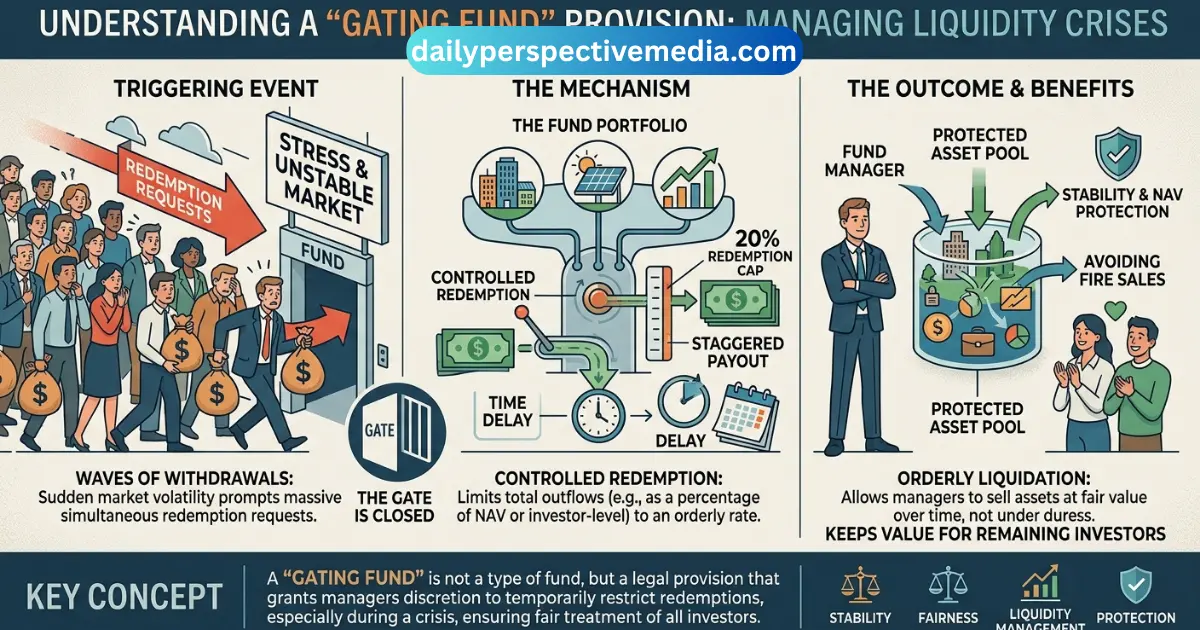
A gating fund is one of the most misunderstood yet critical mechanisms in the world of investment management. When markets turn volatile or investors rush to withdraw their money all at once, fund managers sometimes activate a “gate” — a temporary restriction on redemptions designed to protect the fund and its remaining investors. Understanding what a gating fund is, how it operates, and why it exists can help both new and experienced investors make smarter decisions. This article breaks down the concept in simple terms, explores real-world examples, and explains the regulatory landscape surrounding gated funds across major financial markets.
What Is a Gating Fund?
Definition and Core Concept
A gating fund refers to an investment fund — typically a mutual fund, hedge fund, or open-ended fund — that has implemented a “gate” provision. This provision allows the fund manager to limit or completely halt investor withdrawals for a specified period. The purpose is straightforward: to prevent a sudden wave of redemptions from forcing the fund to sell assets at unfavorable prices. In essence, a gate acts as a safety valve, giving the manager breathing room to liquidate holdings in an orderly manner rather than in a fire sale. This mechanism is most common in funds holding illiquid assets, such as real estate, private equity, or thinly traded securities.
Why the Term Matters in Finance
The phrase gating fund has grown increasingly relevant since the 2008 global financial crisis, when several hedge funds froze redemptions to avoid collapsing under mass withdrawal requests. Since then, the term has become a standard part of financial vocabulary, especially among institutional investors, financial advisors, and regulators. Knowing how a gating fund functions is essential for anyone allocating capital to funds with limited liquidity, because it directly affects how quickly — or slowly — an investor can access their money during periods of market stress.
History and Origin of Gating Funds
The concept of a gating fund dates back several decades but gained widespread public attention during the 2008 financial crisis. As credit markets froze and panic spread, thousands of investors attempted to withdraw funds simultaneously from hedge funds and mutual funds holding hard-to-sell assets. Many fund managers invoked gate provisions written into their original fund documents, effectively pausing withdrawals to prevent a collapse. This period cemented gating as a recognized — though controversial — tool. Since then, regulators worldwide have tightened disclosure requirements, ensuring investors are informed upfront about the possibility of a gating fund scenario before they commit capital.
How Does a Gating Fund Work?
The Mechanics of Redemption Gates
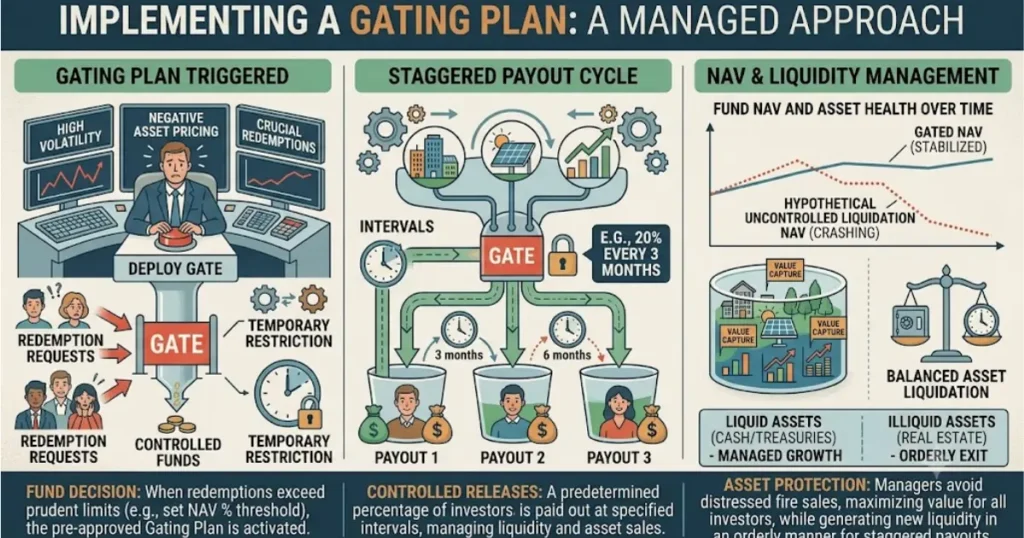
When a fund activates a gate, it essentially caps the percentage of assets that can be redeemed within a given redemption cycle — often monthly or quarterly. For example, if a gating fund sets a 10% gate, only 10% of the fund’s net asset value can be withdrawn by investors during that period, regardless of how many requests are submitted. The remaining redemption requests are either delayed to the next cycle or processed on a pro-rata basis. This structure prevents the fund manager from having to dump assets quickly, which could depress prices and harm everyone still invested in the fund.
Types of Gates (Full Gate vs Partial Gate)
There are generally two types of gates used by a gating fund: a full gate, which suspends all redemptions entirely, and a partial gate, which allows only a limited percentage of withdrawals. Partial gates are more common because they strike a balance between investor liquidity needs and fund stability. Full gates are typically reserved for extreme circumstances, such as a liquidity crisis or a run on the fund. Both mechanisms are usually outlined in the fund’s prospectus or offering memorandum, so investors should always review these documents carefully before investing.
Why Do Funds Impose Gates?
Protecting Remaining Investors
One of the primary reasons a gating fund exists is to protect investors who choose to stay invested. Without a gate, a rush of redemptions could force the fund to sell its best-performing or most liquid assets first, leaving remaining investors with a portfolio of lower-quality holdings. By limiting withdrawals, the fund manager ensures a fairer, more balanced distribution of both gains and losses among all investors, rather than rewarding those who exit first at the expense of those who remain.
Managing Liquidity Risk
Liquidity risk is the core challenge that gating addresses. Many funds invest in assets that cannot be quickly converted to cash without a significant loss in value — think private loans, real estate holdings, or restricted securities. A gating fund structure gives managers the time needed to sell these assets strategically rather than under pressure. This is especially important during market downturns, when asset prices are already depressed and forced selling would only worsen returns for everyone involved in the fund.
Gating Fund vs Suspension of Redemptions
It’s important to distinguish between a gating fund and a full suspension of redemptions. A gate limits withdrawals to a percentage, allowing partial access to funds, while a suspension halts all redemptions completely, often for an indefinite period. Suspensions are typically reserved for more severe situations, such as regulatory investigations, valuation disputes, or extreme market dislocation. Gating is generally viewed as a softer, more investor-friendly mechanism because it still permits some liquidity, whereas a suspension leaves investors with no access to their capital until the fund lifts the restriction entirely.
Real-World Examples of Gating Funds
The Woodford Equity Income Fund Case
Perhaps the most widely cited example of a gating fund in recent memory is the Woodford Equity Income Fund, managed by British fund manager Neil Woodford. In June 2019, the fund suspended trading after it could not meet a wave of redemption requests, largely due to its heavy exposure to illiquid, unlisted companies. The suspension eventually led to the fund’s liquidation, wiping out significant value for thousands of retail investors. This case remains a textbook example of what can go wrong when liquidity mismatches are not properly managed, and it prompted the UK’s Financial Conduct Authority (FCA) to review liquidity rules for open-ended funds.
Hedge Fund Gates During the 2008 Financial Crisis
During the 2008 financial crisis, numerous prominent hedge funds — including some managed by well-known firms — imposed gates to stem the tide of investor withdrawals. Funds holding mortgage-backed securities and other distressed assets faced enormous redemption pressure as panic spread through global markets. By invoking gate provisions, these funds avoided forced liquidation at rock-bottom prices, which ultimately helped preserve value for long-term investors. This period is often referenced by financial historians as the moment gating fund mechanisms became mainstream knowledge rather than an obscure legal clause.
Regulatory Framework Around Gating Funds
SEC Regulations in the United States
In the United States, the Securities and Exchange Commission (SEC) oversees disclosure requirements for funds that include gate provisions. Under SEC rules, mutual funds and hedge funds must clearly disclose any redemption restrictions in their offering documents. Additionally, the Investment Company Act of 1940 provides a framework for how open-ended funds must handle liquidity and redemptions, ensuring that a gating fund cannot impose arbitrary restrictions without prior investor notice and regulatory compliance.
FCA Rules in the United Kingdom
In the United Kingdom, the Financial Conduct Authority (FCA) has tightened rules following high-profile cases like Woodford. The FCA now requires greater transparency around liquidity risk in open-ended funds, particularly those investing in illiquid assets. New guidelines also mandate more frequent liquidity stress testing, ensuring that a gating fund scenario is less likely to catch investors off guard. These reforms reflect a broader global trend toward stricter oversight of liquidity management practices in the asset management industry.
Pros and Cons of Gating Funds
Advantages for Fund Managers and Remaining Investors
For fund managers, a gating fund structure offers valuable flexibility during turbulent markets. It prevents forced asset sales, protects the fund’s long-term value, and ensures fairer treatment among all investors. For remaining investors, gates can actually be beneficial — they reduce the risk of the fund becoming a “fire sale” and preserve the possibility of recovering value once markets stabilize. In many cases, funds that gate responsibly and communicate transparently retain investor trust even after imposing temporary restrictions.
Disadvantages for Investors Seeking Liquidity
On the flip side, a gating fund can be frustrating — even damaging — for investors who need immediate access to their capital. Retirees, institutions with cash flow obligations, or investors facing emergencies may find themselves unable to withdraw money when they need it most. This lack of liquidity can create financial hardship and erode trust in the fund manager, even if the gate was implemented for sound, protective reasons. This is why understanding a fund’s liquidity terms before investing is so crucial.
Impact on Investor Confidence
Whenever a gating fund situation arises, it tends to shake investor confidence — not just in that specific fund, but sometimes across an entire asset class. News of gating can trigger panic among investors in similar funds, leading to a broader wave of redemption requests industry-wide. Fund managers who communicate clearly, provide regular updates, and demonstrate a credible exit strategy tend to retain more investor goodwill. Conversely, poor communication during a gating event, as seen in some past cases, can lead to reputational damage that lasts long after the fund itself has resolved its liquidity issues.
How to Identify Risk of Gating Before Investing
Before committing capital, savvy investors should look for several warning signs that may indicate a higher risk of a future gating fund scenario. These include:
- Heavy concentration in illiquid or unlisted assets
- A history of redemption restrictions in the fund’s past
- Vague or unclear language regarding liquidity terms in the prospectus
- Rapid asset growth without a corresponding increase in liquid holdings
- Negative news coverage or regulatory scrutiny
Reviewing a fund’s liquidity policy, redemption history, and asset composition can help investors avoid unpleasant surprises down the road.
Alternatives to Gating Funds
Some fund structures are specifically designed to avoid the need for gating altogether. Closed-ended funds, for instance, do not allow continuous redemptions, eliminating the liquidity mismatch problem entirely. Similarly, exchange-traded funds (ETFs) trade on secondary markets, meaning investors buy and sell shares among themselves rather than redeeming directly from the fund. Interval funds offer a middle ground, allowing redemptions only at set intervals, which naturally limits the risk of a sudden liquidity crunch. These alternatives are increasingly popular among investors wary of the risks associated with a traditional gating fund structure.
The Future of Gating Funds in Modern Finance
As global markets become more interconnected and volatile, the role of the gating fund is likely to remain relevant for years to come. Regulators continue to refine liquidity rules, pushing fund managers toward greater transparency and more robust stress-testing practices. Meanwhile, technological advances in portfolio analytics and risk modeling are helping managers better anticipate liquidity crunches before they escalate into full-blown gating events. Ultimately, while gating remains a controversial tool, it continues to serve an important protective function within the broader investment ecosystem.
Conclusion
A gating fund is far more than a technical financial term — it represents a critical safeguard designed to protect both fund managers and investors during periods of market stress. From the 2008 financial crisis to the more recent Woodford Equity Income Fund collapse, history has shown both the necessity and the risks associated with gating mechanisms. For investors, understanding how a gating fund works, recognizing the warning signs, and reviewing liquidity terms before investing can make all the difference in protecting long-term financial goals. As regulations evolve and markets grow more complex, staying informed about gating provisions remains an essential part of responsible investing.
Frequently Asked Questions (FAQs)
1. What is a gating fund in simple terms?
A gating fund is an investment fund that temporarily restricts or limits how much money investors can withdraw, usually to prevent forced asset sales during periods of high redemption demand.
2. Is gating a fund legal?
Yes, gating is legal as long as the provision is clearly disclosed in the fund’s prospectus or offering documents and complies with relevant regulatory requirements, such as those set by the SEC or FCA.
3. How long can a gating fund restrict withdrawals?
The duration varies by fund and jurisdiction, but gates typically last anywhere from a few weeks to several months, depending on market conditions and the fund’s liquidity recovery plan.
4. What is the difference between a gate and a suspension?
A gate limits redemptions to a percentage of fund assets, while a suspension halts all withdrawals completely until further notice.
5. Can I lose money if my fund gets gated?
Gating itself doesn’t cause losses, but it delays access to your capital. Losses typically stem from the underlying market conditions or asset devaluation that triggered the gate in the first place.
6. How can I avoid investing in a gating fund?
Review a fund’s liquidity policy, asset composition, and redemption history before investing, and consider alternatives like ETFs or closed-ended funds if liquidity is a top priority.
7. Why did the Woodford Equity Income Fund get gated?
The fund was gated in 2019 due to heavy exposure to illiquid, unlisted companies, which made it impossible to meet a surge in investor redemption requests.