
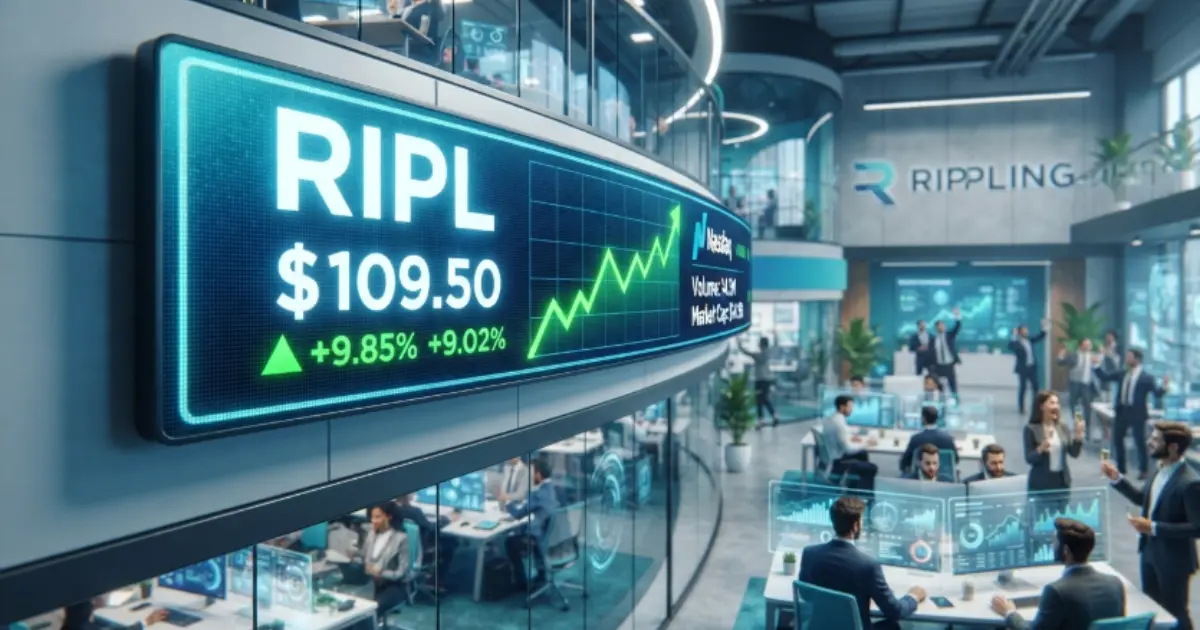
The Rippling IPO has become one of the most talked-about topics in enterprise technology and startup investing circles. As speculation grows around when the company might finally list on a public exchange, interest in its founder, Parker Conrad, has surged just as fast. Conrad’s journey — from a failed fintech startup to a scandal-hit HR company to a $16.8 billion workforce-management giant — reads like a classic Silicon Valley redemption arc. This article explores Parker Conrad’s life, his path to building Rippling, and everything currently known about the anticipated Rippling IPO, based on the latest verified reporting available as of July 2026.
Who Is Parker Conrad?
Parker Conrad was born in 1980 in New York City to Ellen Rouse Conrad, a nonprofit environmental founder, and Winthrop B. Conrad Jr., a senior partner at the law firm Davis Polk & Wardwell. Raised on Manhattan’s Upper East Side, Conrad attended the elite Collegiate School before enrolling at Harvard University in 1998. Long before Silicon Valley, Conrad displayed a scientific mind, winning third place nationally in the Westinghouse Talent Search for research on the neurobiology of sea snails. This blend of intellectual curiosity and relentless ambition would later define his approach to building companies — including the one now at the center of the Rippling IPO conversation.
Early Career and the Road to Entrepreneurship
At Harvard, Conrad served as managing editor of The Harvard Crimson, a role so demanding that he neglected his coursework and was forced to take a leave of absence. He eventually graduated in 2003 with a degree in Chemistry. After a stint as a product manager at biotech firm Amgen, Conrad felt stuck on a slow corporate ladder. When his college roommate, Michael Sha, proposed starting a company together, Conrad jumped at the opportunity — a decision that eventually led him toward the entrepreneurial path that now culminates in speculation about a Rippling IPO.
The SigFig Years: A Painful First Lesson
In 2007, Conrad co-founded Wikinvest, later rebranded as SigFig, a retail investment research platform. Despite years of effort, the company struggled to gain traction, and Conrad often described the business as perpetually “months away from not being able to make payroll.” The partnership with Sha deteriorated, and Conrad left the company in 2012. While painful, this experience gave him a critical insight: outdated, manual back-office processes — especially around health insurance enrollment — were ripe for disruption. That realization directly inspired his next venture.
Founding Zenefits: Fast Growth, Faster Collapse
In 2013, Conrad founded Zenefits, a startup offering free HR software bundled with insurance brokerage services. Fueled by the Affordable Care Act’s rollout, Zenefits exploded in popularity, signing up more than 10,000 companies within 18 months. By 2014, Forbes ranked it among the hottest startups in the country, and its valuation soared to $4.5 billion. However, the meteoric rise masked serious compliance failures — including the use of unlicensed insurance brokers. In February 2016, under mounting regulatory pressure, Conrad resigned as CEO, a fall from grace that seemed, at the time, career-ending.
Hitting Rock Bottom and Finding a Way Back
Following his resignation, Conrad reportedly spent months out of the spotlight, processing the public fallout. One board member famously told him, “you don’t have another company in you.” Rather than accept that verdict, Conrad — encouraged by Sam Altman — began plotting his comeback just six weeks after leaving Zenefits. This resilience became the foundation for Rippling, the company whose future Rippling IPO now dominates fintech and enterprise SaaS headlines nearly a decade later.
Rippling Is Born: A New Vision for HR Software
In April 2016, Conrad co-founded Rippling alongside former Zenefits engineer Prasanna Sankar, who became the company’s CTO. The two worked in stealth mode out of Conrad’s San Francisco home, refining an ambitious idea: build the first true “system of record” for employee data, unifying payroll, benefits, IT provisioning, and device management into one platform. By late 2017, Rippling had 14 employees; by 2018, that number had grown to 60. The foundational technology behind this expansion — often called the Employee Graph — remains central to why analysts view a Rippling IPO as inevitable.
How the Employee Graph Powers Rippling’s Growth
Rippling’s core innovation is the Employee Graph, a continuously updated employee record that automatically triggers downstream workflows. When a new hire joins a company, Rippling can simultaneously configure payroll, assign benefits, provision a laptop, create software accounts, and issue a corporate expense card — all from a single data source. This architecture allows Rippling to launch new product lines, such as travel management or global contractor payments, in just five to six months with minimal added infrastructure cost. It’s this compounding, land-and-expand business model that continues to fuel excitement about a future Rippling IPO.
Surviving the Silicon Valley Bank Crisis
Rippling faced a major test in March 2023 when Silicon Valley Bank collapsed, threatening the company’s ability to process client payroll. Within days, Greenoaks Capital led an emergency $500 million investment to stabilize Rippling’s balance sheet — a striking vote of confidence during an industry-wide panic. This episode demonstrated both the fragility of hyper-growth startups and investors’ continued belief in Rippling’s long-term trajectory, further fueling anticipation of an eventual Rippling IPO.
Funding History and the $16.8 Billion Valuation
Rippling has raised more than $2 billion across multiple funding rounds from investors including Founders Fund, Kleiner Perkins, Bedrock, Initialized Capital, Goldman Sachs, and Y Combinator. Its Series G round, completed in May 2025, valued the company at $16.8 billion, a 23% increase over its $13.5 billion Series F valuation from April 2024. Parker Conrad reportedly retains an ownership stake of roughly 20%, making him a multibillionaire on paper. This funding trajectory is a key data point analysts use when modeling potential terms for the Rippling IPO.
Revenue Growth: The Numbers Behind the Hype
According to private market research, Rippling’s annualized revenue reportedly reached approximately $1 billion by March 2026, up from around $850 million at the end of 2025 — implying roughly 78% year-over-year growth. Some estimates place the company’s earlier 2025 revenue closer to $570 million, reflecting differing methodologies across research firms. Regardless of the exact figure, Rippling’s growth pace at nine-figure-plus scale is considered exceptional for enterprise software, and it’s a central pillar supporting bullish predictions about the Rippling IPO timeline.
The Rippling vs. Deel Legal Battle
No discussion of Rippling would be complete without mentioning its high-profile rivalry with Deel, a competing global payroll and employer-of-record company. The two firms have been locked in ongoing litigation involving allegations of corporate espionage and trade secret theft. Reports in January 2026 suggested the Department of Justice may be examining potential criminal elements of the dispute. This legal overhang is frequently cited as one of the key risks that could delay or complicate any near-term Rippling IPO.
Super Bowl Ad and Mainstream Brand Push
In February 2026, Rippling aired its first Super Bowl advertisement, signaling a deliberate shift from niche enterprise software vendor to a mainstream consumer-facing brand. This marketing push aligns with a broader strategy of building public awareness ahead of a potential listing. Companies preparing for an IPO often invest heavily in brand recognition beforehand, and Rippling’s advertising spend is widely interpreted as one more signal — alongside its funding rounds and leadership hires — that a Rippling IPO is being prepared for, even without a confirmed date.
Why Parker Conrad Says an IPO Isn’t Imminent
Despite the speculation, Parker Conrad has publicly stated on multiple occasions, including in a CNBC interview, that going public is not a near-term priority for Rippling. As of June 2026, the company has not filed a Form S-1 with the U.S. Securities and Exchange Commission, has not hired underwriters for a public offering, and has not announced any specific timeline. Analysts widely interpret this restraint as consistent with Conrad’s cautious, deliberate approach — shaped in part by the hard lessons of Zenefits’ collapse, where hypergrowth outpaced operational discipline.
Analyst Predictions on Rippling IPO Timing
Most market analysts and pre-IPO research platforms currently project a Rippling IPO window sometime in 2027 or 2028, though a handful suggest late 2026 remains technically possible if market conditions and legal matters resolve favorably. Prediction markets tracking the topic have assigned relatively low probabilities — in some cases below 20% — to any formal IPO announcement before mid-2027. Analysts point to the absence of regulatory filings, a lack of underwriter announcements, and Conrad’s own public comments as reasons the Rippling IPO remains a longer-horizon event rather than an imminent one.
Secondary Market Activity and Pre-IPO Investing
Because Rippling remains private, accredited investors have turned to secondary marketplaces such as Forge Global, EquityZen, and Hiive to gain exposure ahead of any eventual Rippling IPO. As of early July 2026, Forge Global listed shares trading around $48.87, though other reports placed secondary prices closer to $41, reflecting roughly a 21% discount to the last primary funding round. This gap suggests some investor caution about sustaining Rippling’s historic growth rates, even as the broader narrative around a future Rippling IPO remains largely optimistic.
Rippling’s Competitive Landscape
Rippling competes in a crowded but massive market against both public and private players. Public comparables include Workday, valued above $50 billion, along with ADP, Paychex, Paycom, and Paylocity. Private rivals include Gusto, Personio, and its litigation adversary, Deel. The global human resources software market was estimated at roughly $19.38 billion in 2021 and has continued expanding rapidly, driven by remote work and increasingly complex global compliance needs — a backdrop that makes the eventual Rippling IPO especially significant for the broader HR-tech investment landscape.
What Investors Should Watch Before the Rippling IPO
For those tracking the Rippling IPO closely, several concrete milestones would signal that a listing is truly approaching: the hiring of investment bank underwriters, the confidential or public filing of an S-1 registration statement, resolution of the Deel litigation, and sustained revenue growth without reliance on emergency fundraising. Until these signals emerge, most credible analysts recommend treating Rippling IPO timelines as speculative. Retail investors seeking exposure to the HR-software theme in the meantime are generally directed toward already-public alternatives like Workday or ADP.
Parker Conrad’s Leadership Style
Colleagues and industry observers describe Conrad’s leadership as uncompromising when it comes to product quality, often rejecting the notion that speed and excellence must be traded off against one another. Having lived through both a slow-burning failure at SigFig and a dramatic public collapse at Zenefits, Conrad has cultivated a reputation for building durable, deeply integrated systems rather than chasing short-term growth optics. This philosophy underpins Rippling’s architecture and, by extension, shapes how the company is approaching the milestones that would eventually lead to a formal Rippling IPO.
Conclusion
The story of Parker Conrad and the Rippling IPO is ultimately a story about resilience, reinvention, and disciplined ambition. From a failed fintech startup to a regulatory scandal at Zenefits, Conrad transformed hard-earned lessons into the foundation of one of the fastest-growing enterprise software companies of the decade. While Rippling’s $16.8 billion valuation, near $1 billion in annualized revenue, and aggressive marketing push all point toward an eventual public listing, Conrad himself has made clear that the Rippling IPO is not an immediate priority. For now, investors, competitors, and HR professionals alike will simply have to keep watching — because when Rippling does finally ring the opening bell, it’s likely to be one of the biggest enterprise software listings in years.
Frequently Asked Questions (FAQs)
1. What is the Rippling IPO, and has it happened yet? The Rippling IPO refers to the anticipated public stock market listing of Rippling, the workforce management software company. As of July 2026, Rippling remains private and has not filed an S-1 with the SEC.
2. Who founded Rippling, and when? Rippling was founded in April 2016 by Parker Conrad and Prasanna Sankar, following Conrad’s earlier resignation from Zenefits.
3. What is Rippling’s current valuation? Rippling was last valued at $16.8 billion following its Series G funding round in May 2025, though secondary market pricing in 2026 has fluctuated below that figure.
4. When is the Rippling IPO expected to happen? Most analysts expect a Rippling IPO in the 2027–2028 timeframe, though CEO Parker Conrad has stated there are no confirmed near-term plans.
5. Can retail investors buy Rippling stock before the IPO? Currently, only accredited investors can access Rippling shares through secondary marketplaces like Forge Global, EquityZen, or Hiive. Retail investors must wait for a public listing.
6. Why did Parker Conrad leave Zenefits? Conrad resigned as Zenefits CEO in February 2016 amid regulatory scrutiny over compliance failures, including the use of unlicensed insurance brokers.
7. Who are Rippling’s main competitors? Rippling competes with public companies like Workday, ADP, and Paycom, as well as private rivals such as Gusto, Personio, and Deel, with whom it is currently engaged in litigation.